ABOUT rE:CENT

Founded in 2012 at the Department of Art History, Faculty of Arts, Masaryk University, Brno, as the Center for Early Medieval Studies, RE:CENT Center for Medieval Visual Cultures and Research Communication was established to reinvigorate the study of the Middle Ages and premodern visual cultures across the world. Over the years, it has grown into a vibrant research center where scholars, students, and the wider public come together to explore the past through interdisciplinary dialogue, creativity, and collaboration. By fostering exchanges between different fields and perspectives, RE:CENT seeks to expand our understanding of historical cultures and their lasting resonance in the present.

As of 2025, RE:CENT’s new name reflects its broader mission — one that goes beyond research to cultivate an interdisciplinary and creative environment. It brings together scholars, graphic designers, illustrators, filmmakers, science communicators, journalists, and media specialists, fostering collaboration across fields. This collective energy fuels a diverse range of projects: from academic journals and books to films, podcasts, and social media content. Our team organizes conferences, workshops, field trips, and a public lecture series (StředověC JinaX), all designed to bridge the gap between academia and society.
We see history not as a relic of the past, but as a key to understanding the present. Through images, art, and historical narratives, the RE:CENT team seeks to shed light on contemporary socio-cultural issues, tracing the origins of marginalization while also highlighting sources of resilience and transformation. More than an object of study, the past is a space of inspiration, emotion, and discovery, woven with stories that continue to shape who we are today.

Since 2014, RE:CENT has been home to Convivium: Exchanges and Interactions in Premodern Cultures, an internationally peer-reviewed journal that sets a global standard for art-historical scholarship. With its striking visual design and commitment to intellectual rigor, Convivium stands among the most aesthetically refined journals in the field. In 2024, we expanded our publishing ventures with re:vize, a Czech-language journal that brings historical discourse into public debate through essays, interviews, and opinion pieces. Alongside these periodical publications, our book series continue to engage diverse audiences worldwide, sharing the passion for medieval art — and beyond.

RE:CENT is more than a research center; it is a dynamic intellectual and creative hub. We invite you to join us in redefining how we study, share, and experience the richness of premodern cultures.

prof. Ivan Foletti, M.A., Ph.D., Head of the Center

HANS BELTING LIBRARY

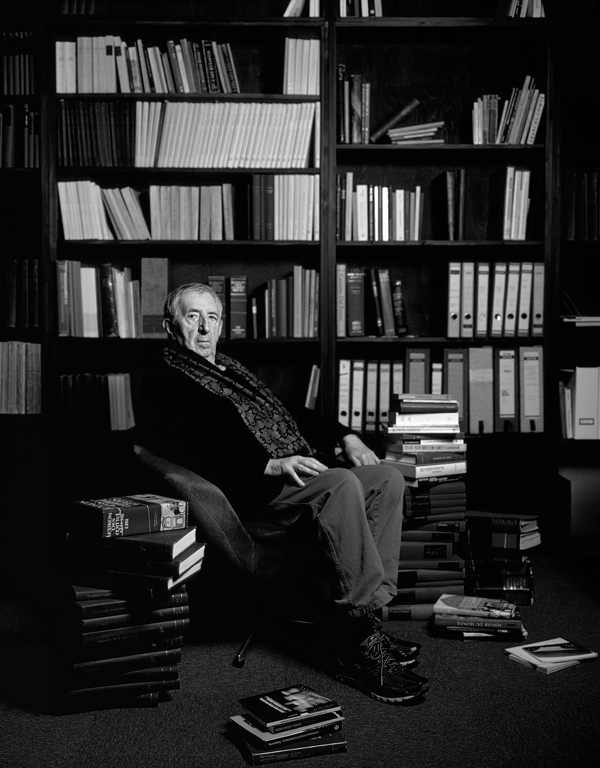
One of the most important art historians, Hans Belting (1935-2023), together with Christa Belting-Ihm, donated their collection of literature on medieval art to the Center for Medieval Visual Cultures and Research Communication at the Department of Art History, Faculty of Arts, Masaryk University, allowing for the establishment of a library named in honor of the donor. With the quality of the collection acquired, the Center rises to the level of major European institutions.

The donated collection contains a number of works that form the essential pillars for the study of medieval art, but which were generally lacking in Central European library collections. This mainly concerns literature dedicated to manuscripts (mainly from the Eastern world and the Apennine peninsula), Constantinople, Venice, southern Italy, Rome, Ravenna, Russia, and the Caucasus. Now, the Hans Belting Library includes not only extensive literature dedicated to the study of medieval art, but also rare facsimiles (e.g. Vienna Genesis, Chludov Psalter, Utrecht Psalter, Rotulus Exultet, etc.). A large part of the collection focuses on the study of the monumental art of the Christian East, from Constantinople to the Caucasus to Egypt and Syria. An important section is also devoted to iconic paintings, called “icons”. Other notable components of the library include dozens of volumes of Greek and Latin sources, and an extensive collection thematising the Cathedral of St. Mark in Venice. In addition, the collection encompasses a series of several periodicals, especially Dumbarton Oaks PapersJahrbuch für Antike und Christentum, and Münstersche Mittelater-Schriften, as well as a stunning collection of several hundred solely printed papers – now a dying form of scientific literature – often gifted by such great scholars in the field as Kurt Weitzmann, Ernst Kitzinger, and Richard Krautheimer.

Yet another valuable section of the library is a part of Belting’s personal archive. Here, it is possible to browse through the complete photo library of the donor, his personal notes, and several of his unpublished, hand-written articles.

The library is accessible to anyone interested in the subject, especially to specialized researchers from the Czech Republic, but also to students, who previously often had to travel abroad to get hold of such quality literature. The library is located in building “K” of the Faculty of Arts, Masaryk University, at Veveří Street in Brno. With the capacity of twenty-six learning places and, above all, direct access to books, it provides researchers with a high-quality study area as well as likeable working conditions. The actual space of the library has come into being primarily thanks to the significant support of the Dean of the Faculty of Arts, Milan Pol, and the Head of the Department of Art History, Ondřej Jakubec.


HERBERT L. KESSLER PRIZE

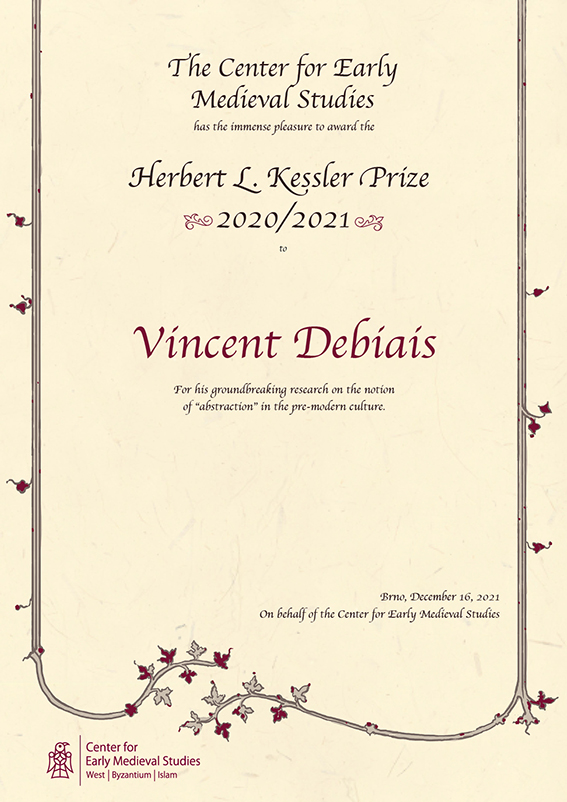
Each year since 2017, the Center for Medieval Visual Cultures and Research Communication Committee has the pleasure to award the Herbert L. Kessler Prize, named after one of the most influential medieval art historians and a founding member of the Center. Herbert L. Kessler not only provided a decisive inspiration and impulse to the development of the Center and its intellectual foundations, but also to those of its periodical Convivium. The award recognizes individuals who have contributed most significantly to the support and development of the Center for Medieval Visual Cultures and Research Communication and of its activities. It is handed out annually during the Christmas celebrations of the Center, in Brno.

Recipients of the Herbert L. Kessler Prize

2023 – Anna Kelblová
2022 – Michele Bacci
2021 – Vincent Debiais
2020 – Jiří Kroupa
2019 – Tanja Michalsky
2018 – Elisabetta Scirocco
2017 – Ondřej Jakubec

AF RE:CENT Prize

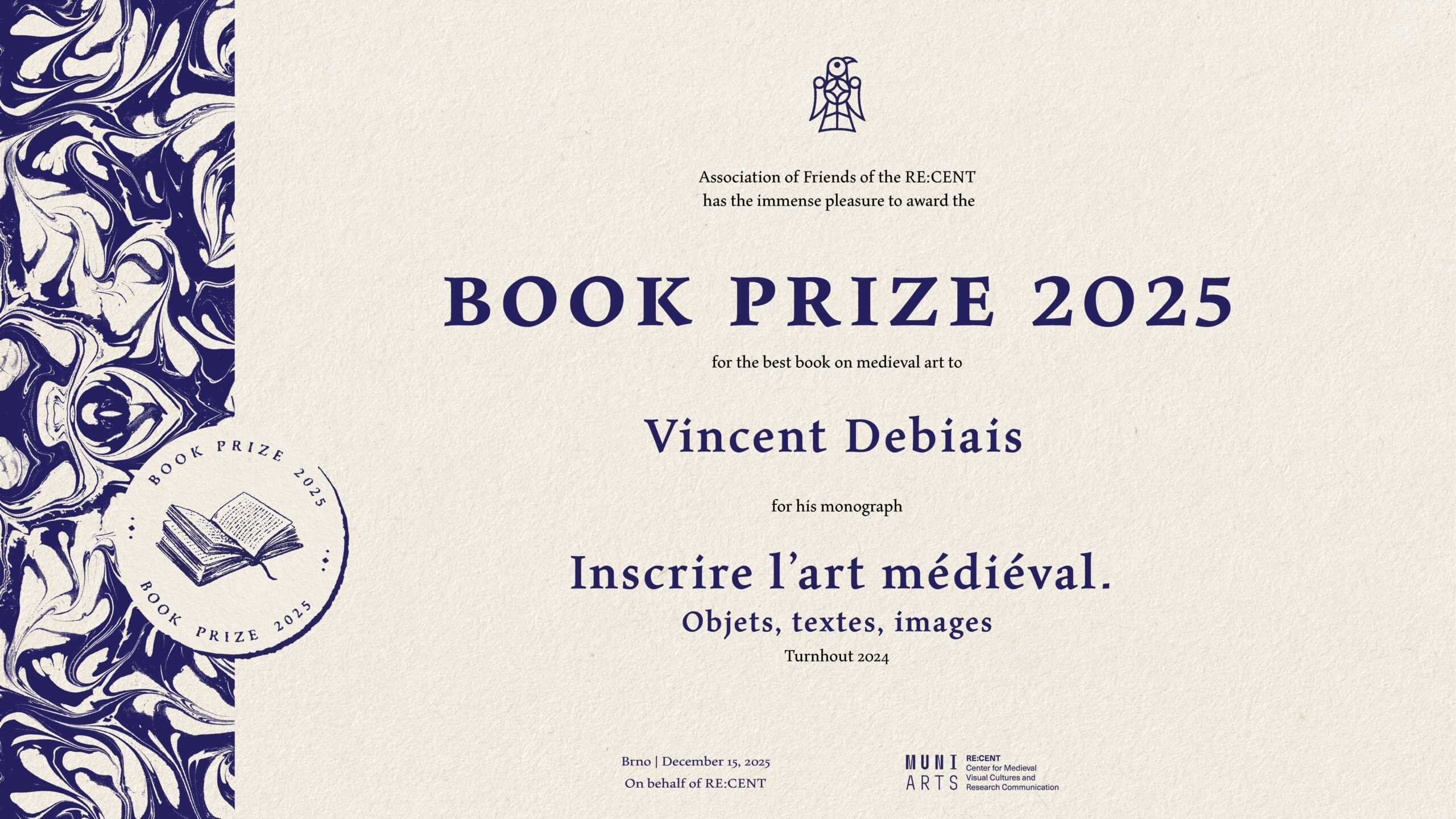
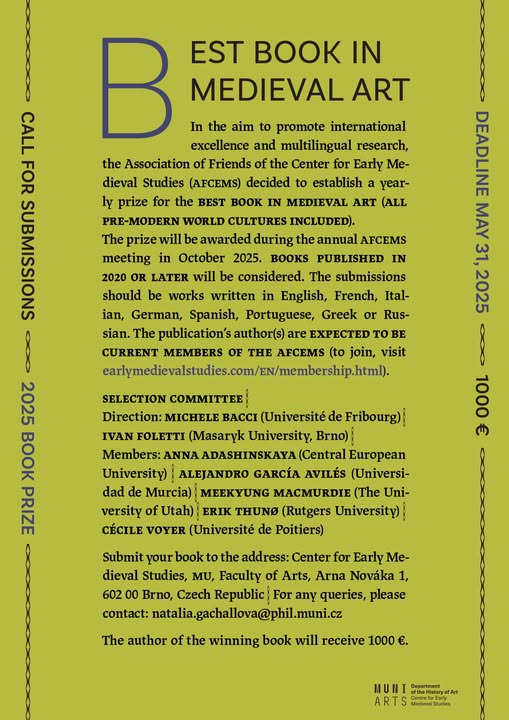
In the aim to promote international excellence and multilingual research, the Association of Friends of the Center for Medieval Visual Cultures and Research Communication (AF RE:CENT) has established a yearly prize for the best book on medieval art (all pre-modern world cultures included). The prize is awarded annually at the end of the year or later. The selection board is directed by Michele Bacci (Université de Fribourg) and Ivan Foletti (Masaryk University, Brno) and includes leading experts in the field from all over the world.

We accept submissions in English, French, Italian, German, Spanish, Portuguese, Greek, or Russian. The publication’s author(s) are expected to be current members of the AF RE:CENT (to join, visit our website’s Membership Page).

The author of the winning book will receive € 1000 or our publications in the value of 1200 €.

Recipients of the AF RE:CENT Prize

2025 – Vincent Debiais
2024  Michael Bintley & Pippa Salonius
2023 – Licia Buttà
2022 – Amy Neff

AF RE:CENT Prize 2025

ADVISORY BOARD

Starting from October 2019, the Center for Medieval Visual Cultures and Research Communication is honored to have established an advisory board composed of international and confirmed scholars of the field of art history.

The main objective of this board is to provide mentorship and advice regarding the scientific and publishing activities of the Center. Since the Center, now seven years old, and its periodical Convivium, have made an integral part of the study and research process to share ideas and experiences, the gatherings of the board will be also be an occasion for scholars to regularly meet in Brno, and, on those occasions, to organize authentic convivia.

MEMBERS OF THE ADVISORY BOARD:

Michele Bacci (University of Fribourg)

Hans Belting (Zentrum für Literatur- und Kulturforschung, Berlin)

Klára Benešovská (Academy of Sciences of the Czech Republic, Prague)

Philippe Cordez (Deutsches Forum für Kunstgeschichte, Paris)

Sible de Blaauw (Radboud University, Nijmegen)

Francesca Dell’Acqua (Università di Salerno)

Jaś Elsner (University of Oxford)

Finbarr Barry Flood (New York University, Silsila Center for Material Histories)

Ondřej Jakubec (Masaryk University, Brno)

Herbert L. Kessler (Johns Hopkins University, Baltimore)

Jan Klípa (Academy of Sciences of the Czech Republic, Prague)

Tanja Michalsky (Bibliotheca Hertziana, Max-Planck-Institut für Kunstgeschichte, Rome)

Bissera Pentcheva (Stanford University)

Serena Romano (University of Lausanne)

Elisabetta Scirocco (Bibliotheca Hertziana, Max-Planck-Institut für Kunstgeschichte, Rome)